Recent constructions, driven by the RE2020 and its large glass surfaces, multiply situations of overlooking from above. Continuous balconies, elevated terraces, roof windows: the problem no longer comes solely from the neighbor across the street, but from the one who overlooks. Preserving privacy in this configuration requires different solutions than those intended for a horizontal view.
Overlooking from above and legal framework: what the Civil Code really imposes
Before choosing a technical solution, it is essential to understand what the law protects and what it does not. Articles 678 and following of the Civil Code define the rules of direct and oblique views between properties. A direct view imposes a minimum distance between the opening and the boundary line.
Feedback from property managers and lawyers specializing in real estate law indicates an increase in disputes related to overlooking in condominiums, particularly in buildings with more than four floors equipped with continuous balconies. Recent case law regularly reminds of these distance rules, but they do not cover all situations, especially when the view comes from a neighboring building and not from an adjoining property.
In condominiums, the regulations may restrict outdoor installations (trellises, awnings, privacy screens fixed to the façade). Checking this document before any purchase avoids a dismantling imposed by the property manager. To delve deeper into techniques to avoid high views, there are dedicated resources for this specific configuration.

Electrochromic glazing: a suitable response for roof windows
Most content on overlooking suggests opaque adhesive films or frosted glass. These solutions work against a horizontal view but pose a problem against overlooking from above: they eliminate natural light across the entire glass surface, permanently.
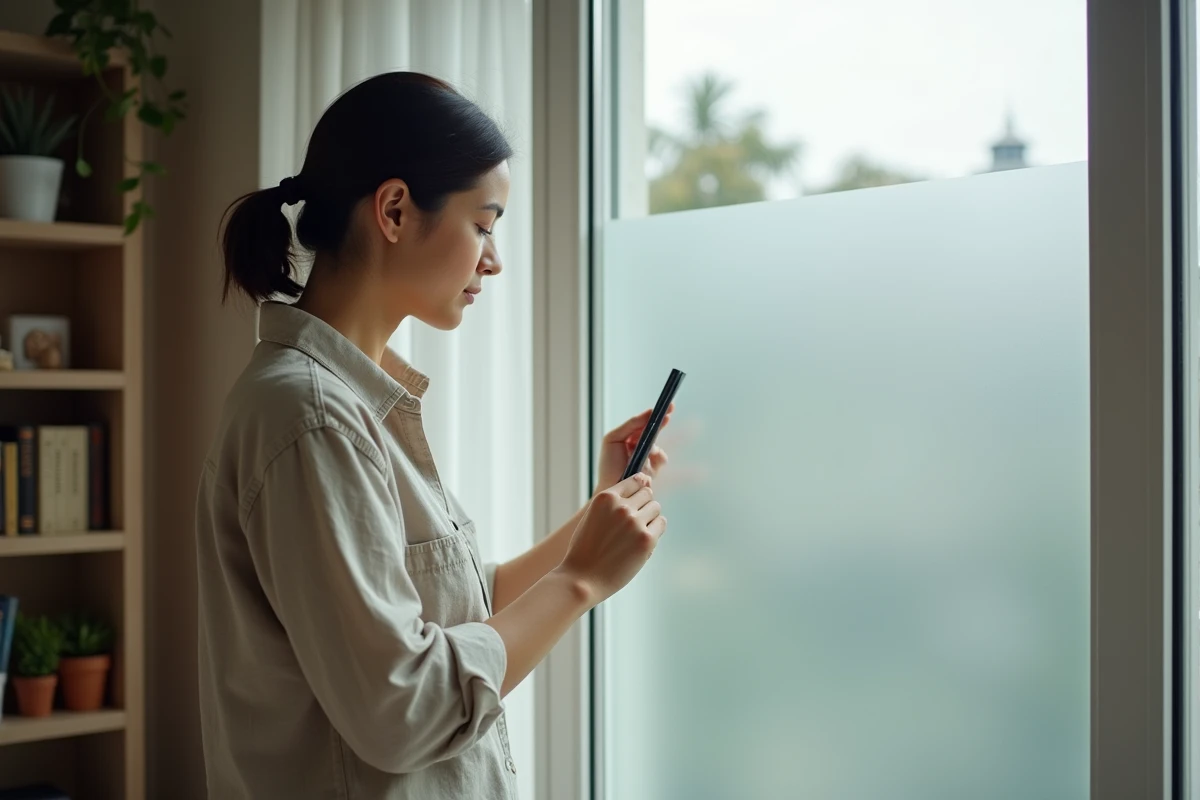
In recent years, manufacturers like Saint-Gobain Glass and AGC Glass Europe have offered switchable liquid crystal glazing. The principle: an electric impulse changes the alignment of the crystals in the glazing, which shifts from transparent to translucent in a few seconds. Light still passes through the glass, but the view is obscured.
This technology is particularly relevant for roof windows and tall sliding doors, where a traditional blind would create a permanent shadow. The cost remains significantly higher than traditional glazing, and installation requires an electrical connection in the frame. Field feedback varies on the long-term durability of liquid crystals, but the technology is becoming more reliable from generation to generation.
Outdoor solutions against visual intrusion: pergola, sail, and elevated vegetation
A view coming from above cannot be blocked by a fence. The logic changes: it is necessary to create a horizontal or sloped plane above the area to be protected, not a vertical plane.
Bioclimatic pergola with adjustable slats
The adjustable slats allow modulation of shading according to the angle of the view. Closed at a precise angle, they block the downward view while allowing air circulation and filtering lateral light. This type of pergola offers simultaneous control of privacy and sunlight, which also meets the thermal comfort requirements related to large glass surfaces encouraged by the RE2020.
Inclined shade sail and elevated reed screen
For tighter budgets, a shade sail stretched diagonally between a high point on the façade and a lower post creates a sloped plane that intercepts the descending view. The reed screen fixed to an elevated structure (light pergola, metal posts) operates on the same principle, with a more natural appearance.
Both solutions share a limitation: they reduce the brightness of the terrace or balcony. The choice of material (density of the weave of the sail, thickness of the reed) determines the compromise between shading and light.
Wide-spreading trees and climbing plants on a high structure
Some fast-growing species with a wide-spreading habit (catalpa, plane tree mulberry) form a natural umbrella that blocks the downward view. On a balcony, climbing plants like star jasmine or clematis, guided on an overhanging trellis, produce the same effect on a smaller scale.
- The catalpa reaches a sufficient span to cover a medium-sized terrace in a few seasons but loses its leaves in winter.
- The star jasmine remains green year-round in regions with a mild climate, ensuring permanent shading.
- The clematis grows quickly but requires regular pruning to maintain dense foliage at the upper trellis level.
Blinds and films for high openings: combining privacy and natural light
For vertical openings exposed to a high view (sliding door facing a taller building), interior blinds remain the most accessible option. Vertical adjustable blinds allow deflecting a descending view without completely blocking light. The angle of inclination of the slats is adjustable based on the height of the overlooking.
Mirror effect adhesive films, often recommended, have a rarely mentioned limitation: their reflective effect depends on the difference in brightness between the inside and outside. In the evening, when the interior is lit, the mirror film becomes transparent from the outside. A blind or curtain then remains necessary as a complement.
Micro-perforated films offer an interesting alternative: they maintain the view from the inside to the outside while significantly reducing visibility in the other direction, both during the day and in the evening. Their perforation density determines the level of obscuration.
- Mirror film: effective during the day, transparent at night, requires a complement.
- Micro-perforated film: stable obscuration day and night, but slightly reduces indoor brightness.
- Frosted film: total obscuration in both directions, eliminates the view to the outside.
The choice depends on the priority given to light, view, or permanent privacy. In a situation of overlooking from above, combining a micro-perforated film on the upper part of the opening with an adjustable blind on the lower part offers a good balance between these three parameters.