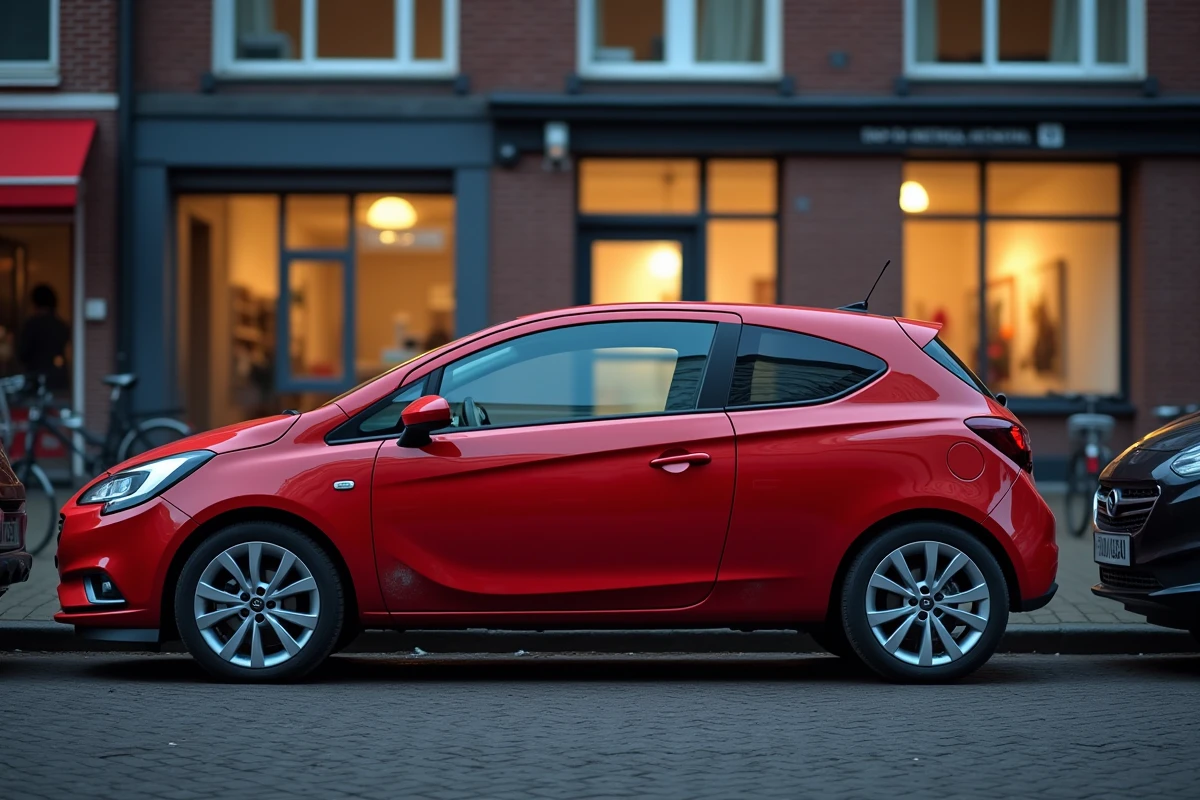
The Opel Corsa has been among the best-selling city cars in Europe for several decades. This popularity has a downside: the model regularly appears in the rankings of the most stolen cars in France. To understand this overrepresentation, one must examine what in the design of certain generations of the Corsa facilitates the work of thieves.
Opel Corsa and Car Theft in France: Available Data
The 2024 report published by L’Argus on January 17, 2025, regarding the most stolen cars places city cars and compact cars (Clio, 208, Corsa, Polo) among the most affected models. The Corsa does not dominate this ranking alone, but its recurring presence deserves to be put into perspective with its vehicle fleet and the type of theft experienced.
| Characteristic | Opel Corsa (city car) | Luxury SUV |
|---|---|---|
| Dominant type of theft | Burglary theft in parking | Violent theft (car-jacking, home-jacking) |
| Context | Residential parking, public road | Home, private parking |
| Frequent method | OBD injection, electronic neutralization | Intimidation, key theft |
| Resale profile | Spare parts, export | Whole resale, quick export |
This table highlights a reality often overlooked: the Corsa is stolen discreetly and opportunistically. The theft occurs without confrontation, on vehicles parked in residential areas. This is a very different pattern from that affecting premium SUVs, where physical violence occurs more often.
To read the full article on Aide Auto, the site details the characteristics of each generation in relation to the risk of theft.

Electronic Architecture of Corsa D and E: A Flaw Exploited by Thieves
The technical factor explains a large part of the Corsa’s vulnerability. Generations D and the beginning of generation E share a poorly segmented CAN electronic architecture. This network, which connects the various controllers of the vehicle, becomes an entry point when it is not sufficiently compartmentalized.
Thieves use electronic boxes capable of injecting a signal via the OBD port or behind the headlight assembly. This signal simulates the presence of the legitimate key to the engine control unit. The immobilizer is then neutralized in just a few seconds, without physically forcing the ignition.
Why the OBD Port is a Problem for These Generations
The OBD (On-Board Diagnostics) port is a mandatory diagnostic port on all vehicles. On Corsa D and early E, this port communicates with the main CAN network without a filtering gateway.
A technical report from the CGED (General Council of Studies and Developments of the Paris Police Prefecture), presented at the “Automotive Crime” conference in November 2023, explicitly cites the Opel Corsa among the models where the deactivation of the immobilizer via CAN injection remains feasible with accessible equipment.
More recent generations have begun to integrate gateways that filter commands passing through the OBD port. This evolution complicates the work of thieves, but the fleet of Corsa D and E remains very large, keeping the volume of thefts at a high level.
Vehicle Fleet and Spare Parts: The Economic Engine of Corsa Theft
The technical dimension alone does not explain the phenomenon. The attractiveness of the Corsa for theft networks also relies on a simple economic calculation.
- The fleet of Corsa in France is very significant, generating a constant demand for used spare parts (headlights, bumpers, engines, gearboxes).
- A stolen and stripped Corsa feeds a parallel market where parts are resold quickly, often via online platforms or unregistered scrap yards.
- The low purchase price of the vehicle makes insurance replacements less scrutinized, limiting thorough investigations into each claim.
This economic model works in a loop: the more Corsa there are on the road, the greater the demand for parts, and the more profitable theft remains for organized networks. Conversely, a rare model or one with less sought-after parts is less interesting.

Theft Protection on Opel Corsa: What Actually Works
In light of this observation, Corsa owners (especially generations D and E) have several levers to reduce risk. Not all solutions are equal.
Physical Locking and Visual Deterrence
A mechanical steering wheel or pedal lock remains a real deterrent for opportunistic thieves. The additional time required to remove this device increases the risk of being spotted. Thieves prefer targets that are quick to handle, and a visible anti-theft device may be enough to redirect them to another vehicle.
Electronic Protection of the OBD Port
OBD locking boxes exist and prevent physical access to the diagnostic port. This solution directly targets the injection method used on the Corsa. The cost remains moderate, and installation does not require heavy modifications to the vehicle.
Parking also plays a role: a closed garage or monitored parking significantly reduces exposure to burglary theft. Data from L’Argus confirms that residential parking on public roads concentrates the majority of city car thefts.
The vulnerability of the Opel Corsa to theft is due to the combination of three factors that mutually reinforce each other: an outdated electronic architecture on the most common generations, a massive vehicle fleet that fuels the demand for parts, and a discreet operating mode that limits risks for thieves. As long as these Corsa D and E continue to circulate in large numbers, the model will remain a prime target.