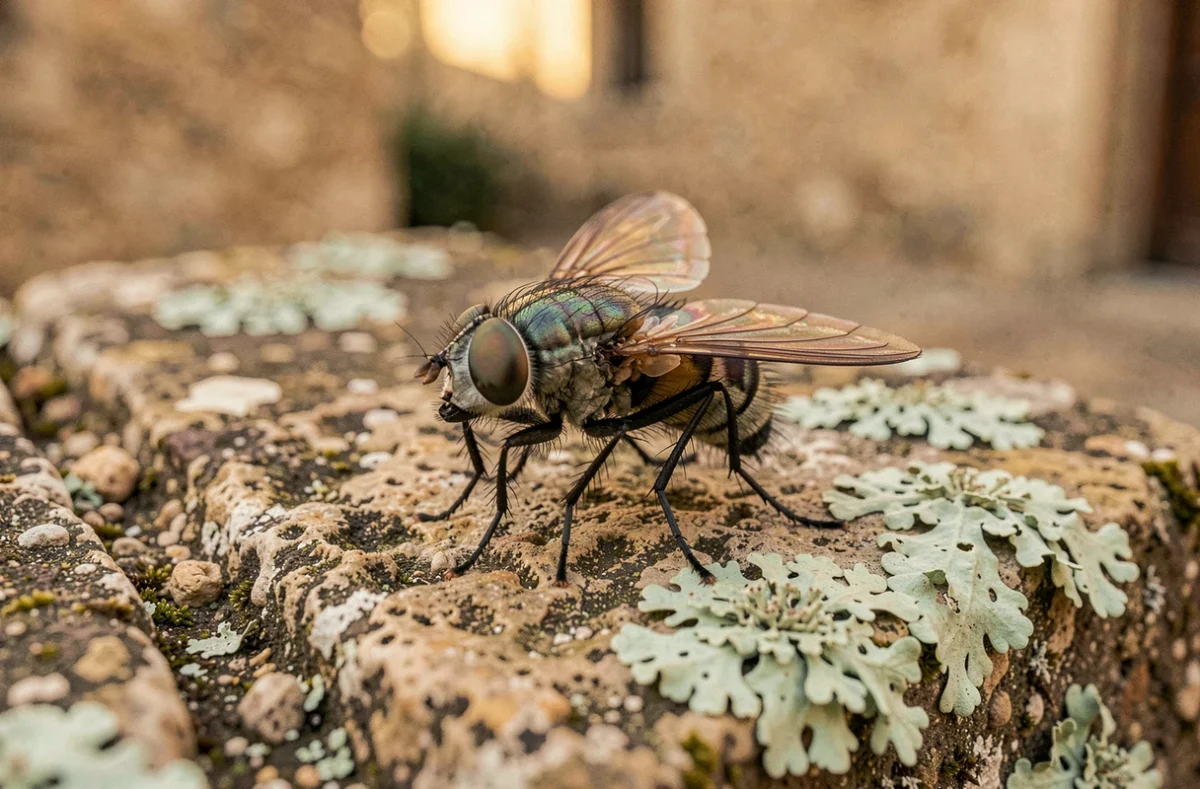
The fly belongs to the order Diptera and is among the oldest insects in existence. Its presence in human habitats, often reduced to a nuisance, carries a dense symbolic weight, constructed over the centuries by religious traditions, mythologies, and very different spiritual frameworks. Understanding what the fly represents requires first untangling what pertains to biology from what belongs to culture.
Decomposition and impurity: why the fly has disturbed since Antiquity
Before any spiritual interpretation, a biological fact structures the symbolism of the fly. This insect is attracted to decaying organic matter: corpses, feces, open wounds, spoiled food. This constant proximity to death and decay has shaped, long before monotheistic religions, a lasting association between flies and impurity.
Ancient civilizations that observed swarms of flies around lifeless bodies did not have microscopes to identify bacteria. The cause-and-effect link between flies and disease remained invisible. The fly thus became a symbol of moral corruption by projection: what touches the dirty ultimately embodies the dirty.
This reading is a cultural product, not an inherent property of the insect. If you explore the spiritual meaning of the fly according to Topitop, you will find that interpretations vary greatly from one tradition to another, proof that the “message” attributed to the fly depends on the perspective one takes on it.

Beelzebub and the demonic fly: an etymology that changes everything
The Western association between flies and demons is largely rooted in one name: Beelzebub, commonly translated as “lord of the flies.” This term appears in the Second Book of Kings in the form Baal-zebub.
Historical studies nuance this translation. The form Baal-zebub could be a polemical distortion of Baal-zebul, which means “exalted lord”. In other words, biblical writers may have deliberately degraded the title of a rival deity by replacing “exalted” with “flies,” transforming a god into a grotesque figure associated with vermin.
This linguistic manipulation has had lasting consequences. In medieval Christian tradition, the fly was gradually assimilated to a demonic sign, a marker of malevolent presence. Many contemporary narratives adopt this reading without mentioning that it relies on a polemical pun several millennia old, rather than on a direct spiritual observation.
What this origin changes for interpretation
Recognizing the constructed nature of this symbolism allows one not to automatically impose a negative framework on the presence of a fly. The symbol is not neutral: it was created in a context of religious rivalry. Taking it at face value ignores its history.
Fly and life cycle: the symbolism of transformation
Apart from the demonic reading, other traditions interpret the fly through its biological cycle. The insect goes through several stages: egg, larva (maggot), pupa, winged adult. This process of complete metamorphosis makes it, in some contemporary approaches, a symbol of personal transformation.
- Larvae develop in decaying matter, illustrating the idea that renewal arises from what seems destroyed or finished.
- The brevity of the fly’s adult life (a few weeks for most species) refers to impermanence and the urgency to act.
- The insect’s adaptability, which colonizes almost all environments in the world, is read as a sign of resilience in the face of obstacles.
This framework of interpretation is more recent and moves away from sacred texts to rely on naturalistic observation. It does not have the historical depth of biblical symbolism, but it offers a less emotionally charged framework.

Presence of flies in the house: spiritual signal or material cause
The most common question remains concrete: what does an invasion of flies in the home mean? Several sites present this phenomenon as a signal of stagnant energy or a spiritual warning. There is no universal spiritual meaning of the fly.
What does exist, however, are well-documented material causes:
- Presence of decaying organic matter (open trash can, forgotten fruit, clogged drain).
- Heat and humidity favoring the rapid reproduction of domestic species.
- Poorly protected openings (windows without screens, faulty seals).
- Proximity to a breeding site, compost, or stagnant water point outside.
Systematically attributing a spiritual cause to the presence of flies without checking these material factors amounts to reversing logical order. The biology of the insect explains its presence in most cases.
When symbolism can make sense
For those who practice a form of spirituality that incorporates signs from daily life, the fly can serve as a personal reminder. The idea is not that the insect carries an objective message, but that the attention given to its presence reveals an inner state: a need to declutter, a feeling of stagnation, resistance to change.
This introspective approach has real psychological value. It becomes problematic only when it replaces the analysis of concrete causes or when it generates anxiety (fear of a “bad omen”).
Fly in dreams: what classical interpretations suggest
The fly regularly appears in dream narratives. Interpretation frameworks vary by school, but certain motifs frequently recur. Dreaming of flies is often associated with a situation perceived as overwhelming or with intrusive thoughts that are difficult to dismiss.
A swarm of flies in a dream generally conveys a feeling of being overwhelmed. A single, calm fly is sometimes read as an invitation to examine a neglected detail. The context of the dream matters more than the presence of the insect itself.
These interpretations do not have established scientific value. They function as tools for personal reflection, just like other forms of dream symbolism.
The fly remains an insect whose symbolic weight has been entirely constructed by human cultures. Whether seen as a sign of corruption, a reminder of impermanence, or simply a dipteran attracted to an overripe banana, the chosen reading says more about the observer than about the animal itself.