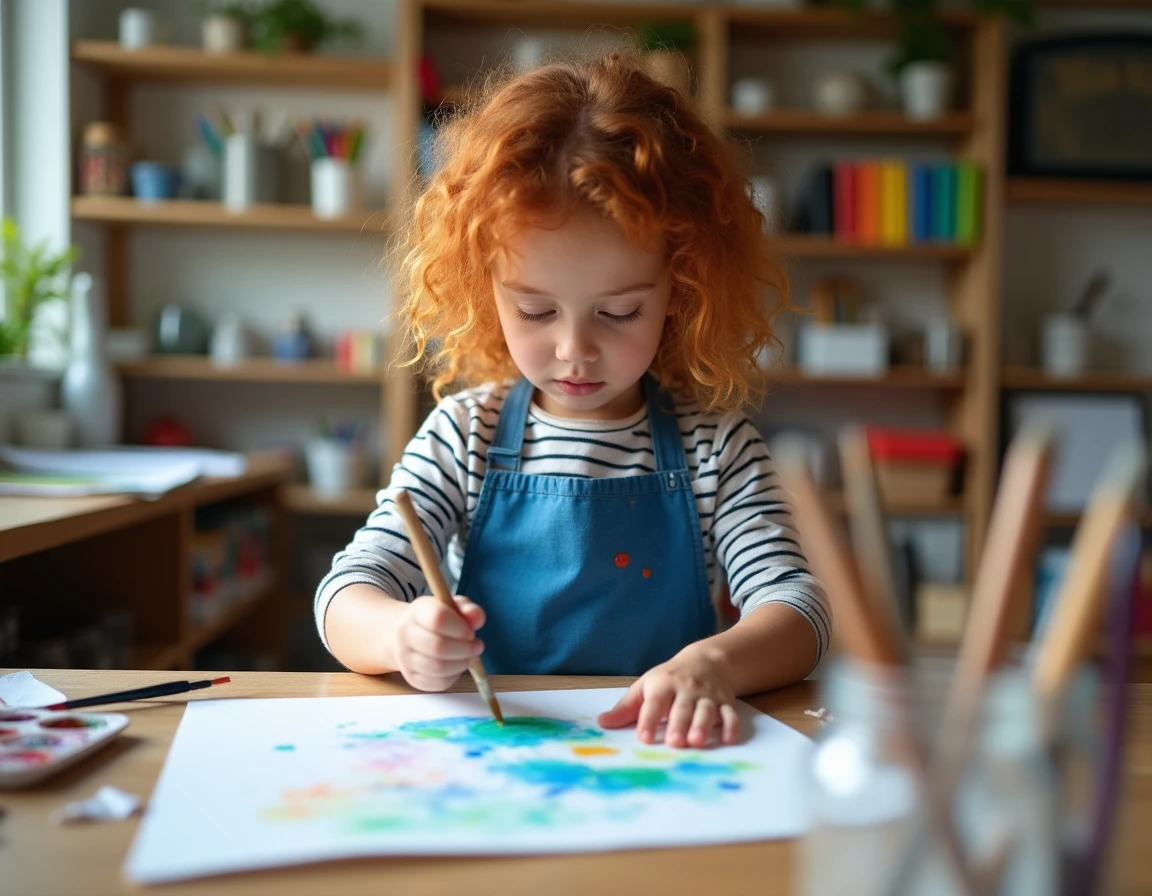
The toy aisles are filled with boxes labeled “creative,” often designed to produce a predictable result in a minimal number of steps. Numbered coloring books, kits with imposed models, guided drawing applications: the commercial offerings push towards activities where the child reproduces more than they invent. The question of what truly stimulates divergent creativity, the kind that allows for the generation of new ideas, deserves to be raised based on what research in developmental psychology documents today.
Divergent Creativity in Children: What Recent Studies Show
Studies published in Computers in Human Behavior (2022-2023) and Frontiers in Psychology (2023) highlight a gap between the promise of so-called creative digital games and their actual effect on divergent thinking. Coloring applications, video editing, or drawing for children primarily engage in guided reproduction rather than free invention.
Free drawing on paper or unstructured symbolic play remains, according to these publications, more effective for developing the ability to produce varied responses to an open problem. This observation does not disqualify all use of digital tools, but it puts into perspective the real creative value of many popular products.
Speech therapists in France and Quebec also observe that children with language or attention disorders gain creative engagement with structured visual supports: silent comics to complete, sequential comics to invent, story construction from pictograms.
Materials with predictable textures (smooth wooden blocks, Lego-type building bricks, paper toys) also facilitate entry into creative play for these profiles. Indeed, ranges designed with this logic can be found on the Ouaps website for children, which offers toys designed to support awakening at different ages.
Creative Games Without Models: Why Raw Materials Prevail
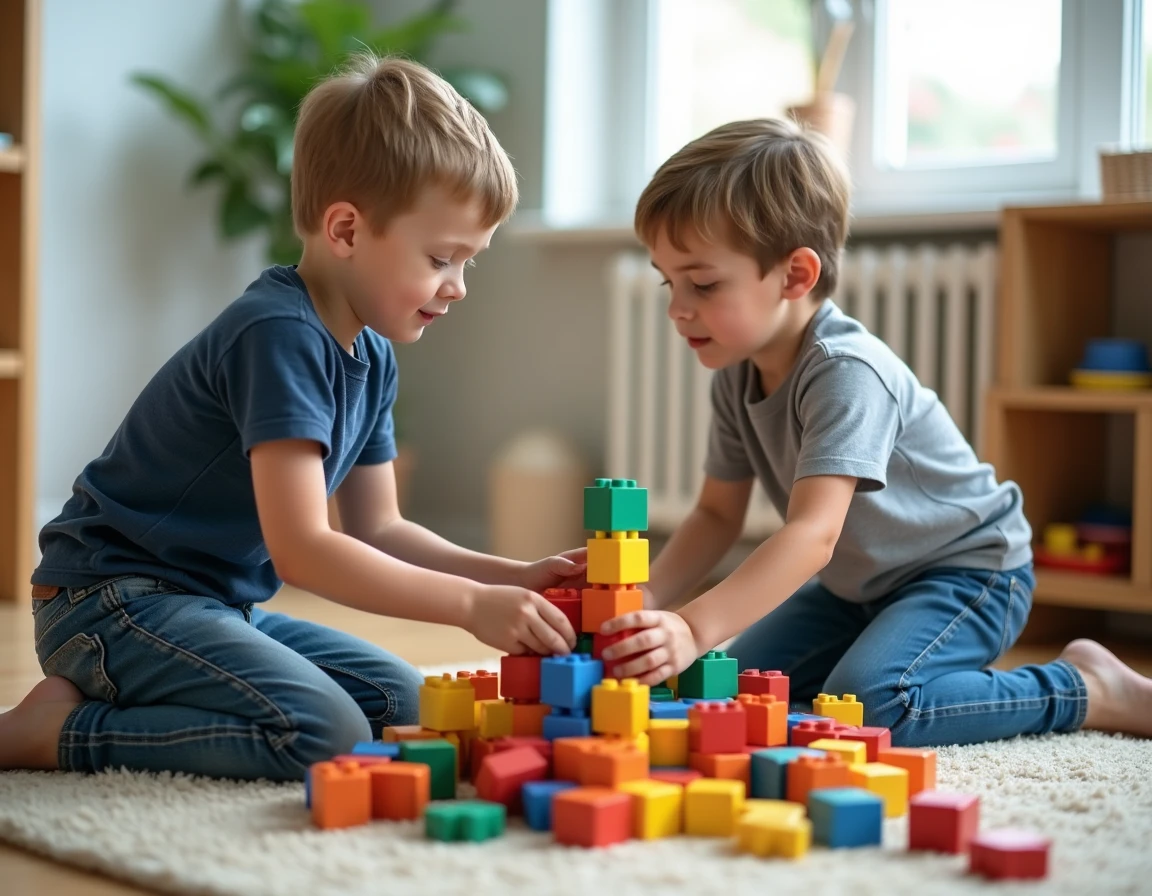
A blank sheet, recycled cardboard, non-themed building boxes: these stripped-down supports generate more divergent creativity than guaranteed-result kits. The reason lies in the absence of closed instructions. When a child receives a kit with a final model to reproduce, they follow a marked path. When they have materials without a predefined destination, they must invent the purpose before even starting.
Since 2023, toy professionals have described a growing parental demand for activities “without preparation, without clutter, with guaranteed results.” This trend, documented in market reports from La Revue du Jouet, is steering the offerings towards more prescriptive products. The paradox is clear: what parents seek in practicality often reduces the creative potential of play.
In contrast, modular suction cup games, repurposable balance boards, or stackable bricks without instructions find a loyal audience in preschools and elementary schools, where teachers measure their impact on children’s imaginative autonomy.
Creative Activities by Age Group: Adapting the Level of Openness
Not all children benefit equally from the same degree of freedom. A two-year-old needs a simple sensory framework (modeling clay, large blocks, shakers) to explore without frustration. From the age of five or six, a child can manipulate narrative constraints: inventing the continuation of a story, building a setting for figurines, drawing a character from an imposed shape.
- Before 3 years: prioritize open sensory play (exploration bins, stacking objects, fabrics of various textures) that engage touch and manipulation without a goal of result.
- From 3 to 6 years: introduce simple narrative supports (puppets, costumes, image theater like kamishibaï) where the child creates their own scenarios.
- From 7 to 10 years: offer open construction challenges (building the longest bridge with cardboard, inventing a functional musical instrument) and cooperative games where creativity serves a collective goal.
The issue is not to ban guided kits but to vary the ratio between directed activities and free play. A child who only engages in activities with closed instructions develops execution skills, not creative ones.
Screens and Children’s Creativity: A Still Uncharted Territory
The available data do not allow for a definitive conclusion about the overall effect of screens. What the studies mentioned above establish is a distinction between passive use (watching tutorials), semi-guided use (numbered coloring applications), and active use (programming a small game, editing a video without a model). Only the last type seems to produce effects comparable to physical creative play.
Field reports vary on this point. Some teachers report that creative tablets motivate children reluctant to draw on paper. Others find that time spent on screens reduces tolerance for boredom, which remains a powerful trigger for spontaneous imaginative play.
Prudence suggests not to directly oppose digital and physical but to observe what the child actually produces. A child who follows a model pixel by pixel on a tablet is not in the same cognitive process as a child who invents a scenario with three figurines and a cardboard box.
Choosing a Creative Game for Children: The Criteria That Matter
In front of a shelf or an online catalog, a few guidelines help distinguish a toy that truly fosters creativity from a product that is merely fun.
- Does the game offer multiple uses not foreseen by the instructions? A modular construction game lends itself to dozens of configurations, while a model kit has only one.
- Does the child decide the purpose or follow a model? Toys without a “expected result” photographed on the box leave more room for invention.
- Does the material tolerate mistakes? Modeling clay can be reshaped, and whiteboard drawings can be erased. A support that allows for trial and error encourages exploration.
- Can the game be combined with other toys or everyday materials? Open-ended universes (generic figurines, neutral blocks) easily mix with other elements, multiplying possibilities.
An expensive and sophisticated toy is not automatically more creative than a roll of kraft paper and some markers. Price does not correlate with the potential for invention, and the simplicity of the support often remains the best indicator of the freedom left to the child.